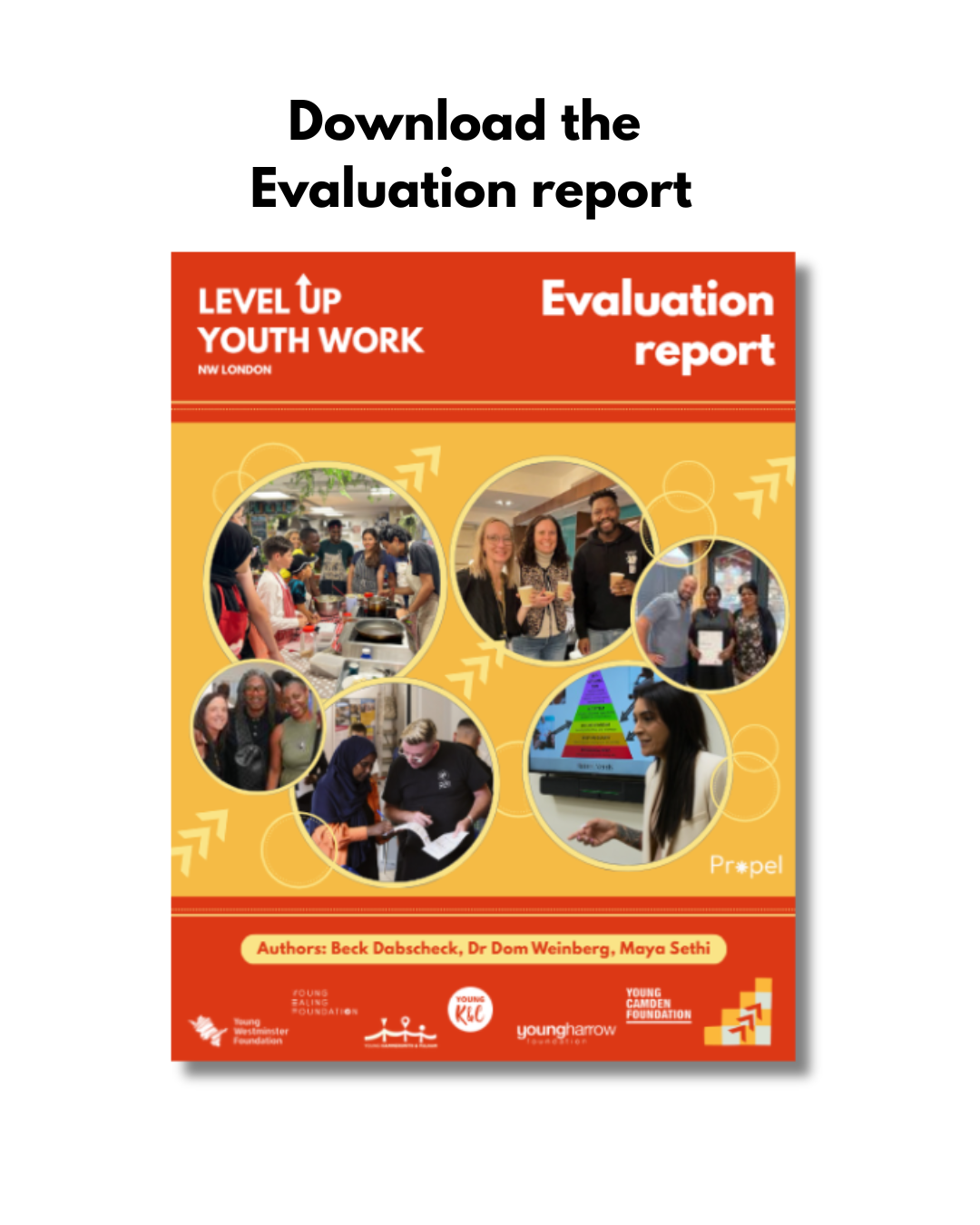


The power of investing in the youth workforce
Learning, support and connection enable the brilliant people who work day in, day out with children and young people to do their best work. Yet too many youth workers have lacked consistent access to these vital foundations.
As Level Up Youth Work draws to a close, an independent evaluation shows what can happen when those pathways are strengthened: practitioners gain confidence, organisations build lasting relationships and the wider youth sector becomes better equipped to support children and young people across north-west London.
Over three years, six Young People’s Foundations turned that principle into practice, combining professional development, accredited qualifications and practitioner forums to strengthen the children’s and youth workforce.
The programme was open across the sector but deliberately prioritised small, grassroots and equity-led organisations, where time and funding for workforce development are often hardest to find. The evaluation suggests that focusing support where barriers were greatest did more than widen access: it helped strengthen learning and connections across the sector.
Building a more connected sector
The evaluation’s clearest message is that workforce development is not only about skills; it is also about connection.
Youth and children’s practitioners work across many settings, often under intense pressure and without regular opportunities to learn alongside peers. Through local forums, training and networking, Level Up Youth Work created space for relationships to grow across organisations – and for individual practitioners to feel part of something larger.
Across 75 practitioner forums, there were 1,128 attendances, with 222 organisations participating each year across the partnership. More important than the scale alone was what those spaces made possible: practitioners shared ideas and resources, formed partnerships and learned from one another in ways that often continued beyond the programme.
Learning, skills and confidence
Demand for high-quality workforce development was clear. Across 127 specialist courses, practitioners took up 1,330 training places, with 124 equity-led organisations benefiting each year. Sessions addressed the complex realities of youth work, from mental health, SEND and inclusion, to safeguarding, healthy relationships, leadership and practitioner wellbeing.
Participants reported tangible gains: 89% improved their understanding, 85% developed new skills and 84% felt more confident as practitioners.
At a time of rising demand and sustained financial pressure, those gains in knowledge, skills and confidence are not incidental; they are part of what helps organisations keep delivering high-quality support.
Creating pathways into youth work
Level Up Youth Work also opened a route into recognised professional development for practitioners who might otherwise have struggled to access it.
Of the 184 practitioners who began a qualification, 156 completed it – an 86% completion rate. More than half were under 25, helping to build the next generation of youth workers and community practitioners.
What we’ve learned
Three lessons stand out:
- Connection reduces isolation and strengthens practice.
- Place-based leadership matters and Young People’s Foundations, with their borough specific focus have been able to develop strong understanding local needs and convene organisations in trusted spaces.
- Workforce development remains under-resourced, particularly for small, grassroots and equity-led organisations – even though the evidence shows that investing in practitioners strengthens organisations and improves support for children and young people.
Looking ahead
The Government’s Youth Matters strategy recognises that every child and young person needs access to high-quality support and opportunities in their community. That ambition depends on a skilled, connected and sustainable workforce.
Level Up Youth Work has shown that investing in people, relationships and local networks creates change that reaches far beyond a training room. The task now is to carry that learning forward, so workforce development is treated not as an optional extra but as essential infrastructure for the youth sector.